

Most companies watch their sales process like a hawk and pay almost no attention to how they spend money. Which is strange, because the spending side is just as full of leaks — they're only quieter. Nobody celebrates a purchase order the way they celebrate a closed deal, so the whole thing runs in the background until an invoice shows up that nobody recognizes.
That background process has a name: procure-to-pay. It's the full path from the moment someone in your company decides they need to buy something to the moment the supplier is actually paid. Get it tight and you spend less, pay on time, and always know what you've committed to. Leave it loose and money slips out in ways that don't show up until the books are being closed.
What procure-to-pay actually covers
Cut through the jargon and it's a sequence:
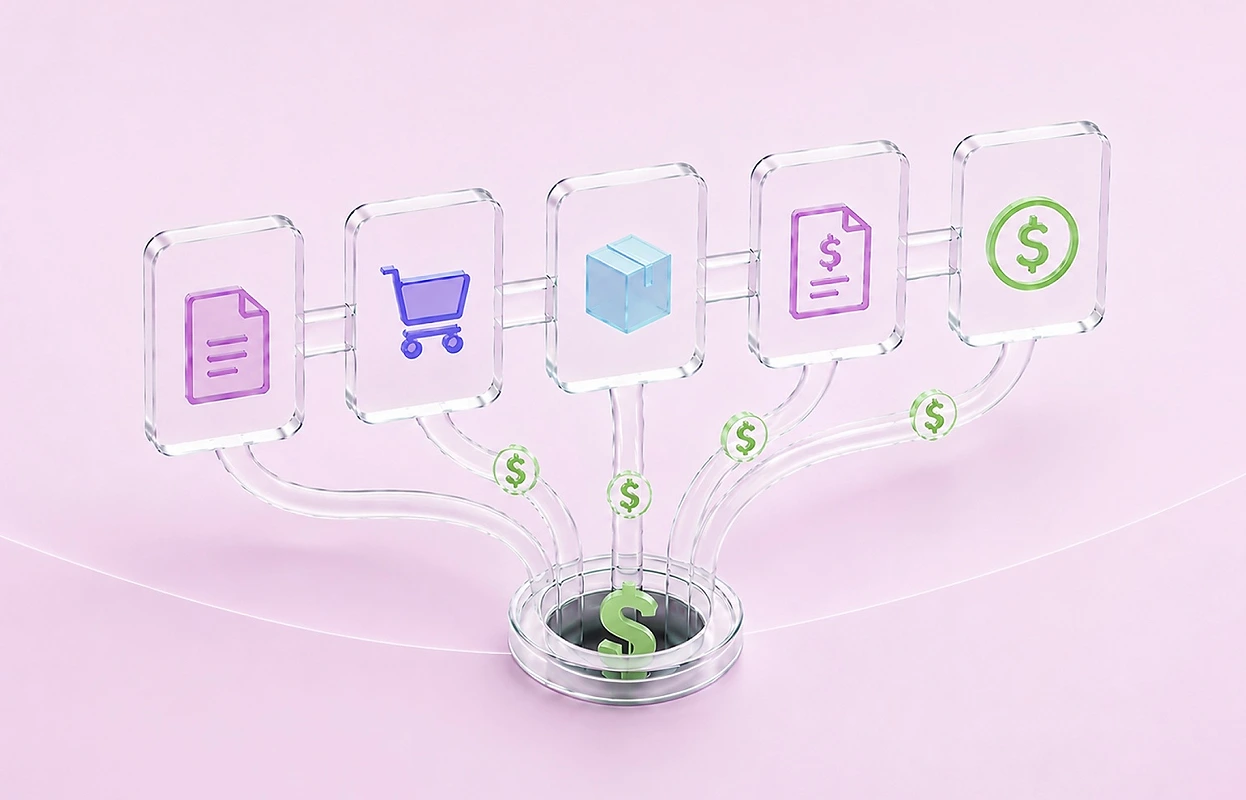
Someone needs something, so they request it. That request gets approved (or it should). A purchase order goes to a supplier. The goods or services show up, and someone confirms they actually arrived and matched what was ordered. The supplier sends an invoice. You check that the invoice, the PO, and the receipt all agree. Then you pay.
Sounds tidy. In practice each of those steps usually lives in a different place — an email here, a spreadsheet there, a stack of paper invoices on someone's desk — and the gaps between them are where the trouble starts.
The leak: buying that nobody approved
When requesting something is harder than just buying it, people just buy it. A manager orders directly from a supplier, skips the approval, and you find out when the invoice lands. This is called maverick spend, and it's incredibly common in companies that run procurement through email and goodwill.
The problem isn't that people are reckless. It's that the official process is slow enough that going around it feels reasonable. So you lose the volume discounts you'd negotiated, you buy from vendors you haven't vetted, and you have no real picture of what you've committed to until the bills arrive.
The leak: the three-way match nobody does
The single most important control in this whole process is the three-way match — confirming that the purchase order, the receipt of goods, and the supplier's invoice all line up before you pay. Did we order it? Did we receive it? Does the invoice match both?
When those three documents live in three different systems, that check is either skipped or done by hand by someone squinting at printouts. So you end up paying for things that never arrived, paying the wrong amount, or paying the same invoice twice because nobody could easily see it had already been handled. Duplicate payments alone quietly cost companies more than most finance leaders would ever guess.
The leak: paying at the wrong time
Pay an invoice late and you burn supplier goodwill and sometimes eat a penalty. Pay it the instant it arrives and you've given up cash you could have held onto, and possibly missed an early-payment discount you were entitled to. Both happen when invoices are processed in a scramble rather than on a schedule — late ones because they got buried, early ones because someone just wanted them off their desk.
Good procure-to-pay means paying on your terms, deliberately, with the discount captured and the relationship intact.
The leak: no idea what you've committed to
Here's the one that bites at the worst moment. A purchase order is a commitment — that money is effectively spent, even though no cash has moved yet. If your committed spend lives in a pile of unconnected POs, your budget reports are telling you a comforting lie. You look like you have room, you approve more spending, and then a month's worth of POs all convert to invoices at once and the number is suddenly very different.
You can't manage a budget you can only see after the money's already gone.
Why adding approvals usually backfires
The reflex when procurement gets messy is to add more sign-offs. More approvers, more forms, more checkpoints. But every step you bolt onto a disconnected process makes the official path slower, which makes going around it more tempting, which creates more of the maverick spend you were trying to stop. You tighten the rules and the leak gets worse.
Control doesn't come from more steps. It comes from steps that are fast and connected enough that following them is easier than not.
What it looks like when the flow is connected
The version that actually works runs as one continuous thread. A request gets approved against a budget that reflects real committed spend, so the approver can see what's already on the hook. The approved request becomes a PO automatically. When the goods arrive, receiving is logged against that same PO. When the invoice comes in, the three-way match happens on its own — PO, receipt, invoice, reconciled without anyone squinting at paper. Finance pays on schedule, captures the discount, and the books reflect it instantly.
Same information, carried from "we need this" all the way to "they're paid," entered once. That's the reason a platform like Mindworks runs purchasing, receiving, and finance on one system instead of three that email each other — so the commitment you approve, the goods you receive, and the invoice you pay are always the same record, and the spending leaks just don't have anywhere to hide.
How to spot your own leaks
You don't need new software to start. Pull last quarter's invoices and check two things: how many were paid without a matching PO (that's your maverick spend), and how many you'd struggle to prove you actually received. Then look at how much approved-but-not-yet-invoiced spend is sitting out there right now that isn't in any budget report.
Most teams find the picture is messier than they assumed — and that the fix isn't more discipline from people, it's a process that stops relying on people to catch what a connected system would catch on its own.